Latest News


Services
 150 Canadian dollars
 100 Canadian dollars
 200 Canadian dollars
How It Works
Welcome to ADAS (Al-Ihsan Datepalm Application Service).Application due date: Ramadhan 30th
Request your institution to directly send the official transcripts to ihsancanadianislamicuniversitytranscript@torontomail.com and for your two references to send the required admission reference documents to adm.al-ihsan.canadian.islamic.university@muslim.com after you have uploaded them in your application.
Our application process comprises faith-centered assessments that ensure candidates align with the Salafi methodology, promoting both academic success and spiritual growth.



Admissions
Admission is rooted in the "Rabbaniyyun" curriculum, focusing on authentic knowledge with excellence as practiced by the best early generations (the Prophet's companions and their followers).
Creed and Methodology (Aqida & Manhaj): Applicants must demonstrate an commitment to the methodology of the Salaf as-Salih—seeking proof directly from the Quran, Sunnah, and the consensus of the Companions, while avoiding religious innovations (Bid'ah).
Character and Sincerity (Ikhlas & Akhlaq): High value is placed on sincerity and good character, modeled after the Prophet Muhammad (ﷺ). Applicants may undergo interviews to assess their drive to implement and lead within their communities.
Foundational Knowledge: For advanced programs, a prerequisite of basic Quranic reading proficiency and a general foundational understanding of Islamic principles is required.
2. Academic & Canadian Regulatory Standards
To meet Canadian degree-granting standards (such as those monitored by the Campus Alberta Quality Council (CAQC) or Ontario's PEQAB), the university must maintain rigorous academic benchmarks.
Secondary Education Prerequisites:
Completion of High School Diploma or equivalent (international equivalents must be assessed).
A minimum grade average (typically 90%) in core subjects like Simplified Arabic, Islamic Sciences, and Quran Memorization.
Language Proficiency:
English: Mastery of the English language (IELTS/TOEFL scores for non-native speakers) to ensure success in a Canadian academic environment.
Arabic: Proficiency in reading Quranic Arabic is often required for core Islamic studies.
Verification & Integrity: Submission of official, verifiable academic transcripts and letters of recommendation from recognized community or academic leaders.
-
Category /Requirement Source/Standard
-
Academic Grade 12 Diploma; Min. 3.0 GPA; Both Arabic and English Proficiency Canadian Degree Standards
-
Islamic Theological Adherence to the Quran, the authentic Sunnah, and understanding of the Salaf Islamic University Core
-
Character Interview & Letters of Recommendation (Tazkiyah) Sunnah Character Standards
-
Administrative Formal application through the ADAS portal ($100 fee) Institutional Policy
-
Note on Status: Al-Ihsan Canadian Islamic University emphasizes a gradual cultivation of students through a "Rabbaniyyun" approach, ensuring they become lifelong learners who can navigate modern ideologies while staying true to their faith.
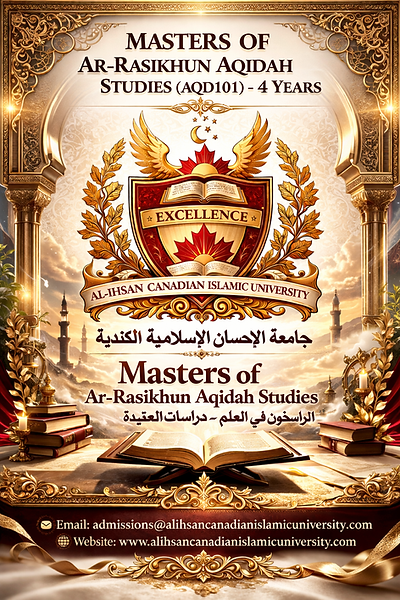
Masters of Ar-Rāsikhūn in ʿAqīdah Studies (AQD101) – 4 Years
Al-Ihsan Canadian Islamic University
Program Description
The Masters of Ar-Rāsikhūn in ʿAqīdah Studies (AQD101) is a rigorous four-year advanced graduate program dedicated to cultivating scholars firmly grounded in Islamic creed (العقيدة) according to the Qur’an, the authentic Sunnah of the Messenger of Allah ﷺ, and the understanding of the best generations — the Companions (رضي الله عنهم), the Tābiʿūn, and those who followed them in excellence.
This program seeks to revive and preserve the pure creed of Ahl al-Sunnah wa al-Jamāʿah — the creed built upon the unequivocal texts (النصوص المحكمة), free from theological distortion (تحريف), negation (تعطيل), anthropomorphism (تمثيل), or speculative innovation (بدعة). Students are trained to approach matters of belief with submission to revelation, sound reasoning in harmony with transmitted knowledge, and reverence for the methodology of the Salaf.
Allah Most High states:
“And whoever opposes the Messenger after guidance has become clear to him and follows other than the way of the believers — We will turn him to what he has chosen.” (Qur’an 4:115)
And He says:
“The first forerunners among the Muhājirūn and the Anṣār and those who follow them with excellence — Allah is pleased with them and they are pleased with Him.” (Qur’an 9:100)
The program therefore centers upon following the path of the earliest generations in understanding Tawḥīd, the Divine Names and Attributes, faith (īmān), decree (qadar), Prophethood, the Hereafter, and the principles that safeguard orthodoxy.
Academic Vision
The Masters of Ar-Rāsikhūn aims to produce scholars who are:
Firmly rooted in textual evidence (راسخون في العلم)
Academically precise and methodologically disciplined
Capable of critical engagement with classical and contemporary theological discourse
Equipped to clarify misconceptions and respond to doubts with wisdom and knowledge
Distinguished by humility, spiritual refinement, and upright character
The Prophet ﷺ said:
“The scholars are the inheritors of the Prophets.”
This program aspires to nurture inheritors who combine knowledge (علم), certainty (يقين), wisdom (حكمة), and integrity (أمانة).
Core Areas of Study
Over four years, students engage in advanced study of:
Tawḥīd al-Rubūbiyyah, al-Ulūhiyyah, and al-Asmāʾ wa al-Ṣifāt
Methodology of Ahl al-Sunnah in affirming the Divine Attributes without distortion
The reality and components of Īmān
Qadar and the Divine Will
Foundations of refuting deviant theological trends past and present
Principles of creed in light of Qur’anic exegesis and authentic hadith
Classical creedal texts with commentary and analytical study
Research methodology in Islamic theology
Students are trained in disciplined reading of foundational texts, comparative theological analysis, and structured research writing rooted in primary sources.
Methodological Framework
The program is built upon the following principles:
Revelation precedes speculation.
The understanding of the Companions is the primary interpretive lens.
Sound intellect never contradicts authentic transmission.
Innovation in creed is rejected; clarity and adherence are upheld.
Knowledge must be accompanied by sincerity and righteous action.
Students are reminded that creed is not merely academic theory but a living reality that shapes worship, ethics, governance, and society.
Graduate Outcomes
Upon completion, graduates will:
Demonstrate mastery of foundational and advanced creedal doctrines.
Articulate orthodox positions with clarity and textual evidence.
Engage responsibly in contemporary theological discourse.
Contribute to scholarship, teaching, and community leadership.
Uphold excellence (الإحسان) in knowledge and character.
Allah says:
“Allah will raise those who believe among you and those who were given knowledge by degrees.” (Qur’an 58:11)
This program represents a commitment to preserving the clarity of Islamic belief while cultivating academic excellence, intellectual discipline, and spiritual refinement — producing scholars who stand firm upon truth with wisdom, balance, and reverence for revelation.
May Allah grant tawfīq and sincerity in all endeavors.


1. Faith-Based & Spiritual Standards (Quran & Sunnah)
In accordance with the university’s mission to follow the Prophet (ﷺ) and his companions, applicants must meet spiritual benchmarks.
Creed and Methodology (Aqida & Manhaj): Candidates must demonstrate a commitment to the creed of the Salaf al-Salih, prioritizing authentic evidence from the Quran and Sunnah over religious innovation (Bid'ah).
Sincerity (Ikhlas): Applicants must undergo a screening to ensure their pursuit of knowledge is for the sake of Allah and the benefit of the community (Naseeha).
Character Assessment (Akhlaq): High moral standing and ethical conduct are mandatory, assessed through letters of recommendation (Tazkiyah) from recognized Islamic authorities or community leaders.
2. Ontario Academic & Quality Standards
To comply with the Post-secondary Education Choice and Excellence Act, 2000, and PEQAB standards, the university must enforce academic rigor comparable to Ontario’s public universities.
Admission Requirements:
Academic Standing: Completion of an Ontario Secondary School Diploma (OSSD) or equivalent with a minimum 90% average (or 3.0 GPA) in at least six Grade 12 U/M courses.
English Proficiency: For non-native speakers, a minimum IELTS score of 6.5 or TOEFL equivalent is required to ensure success in the Canadian academic environment.
Arabic Foundation: Proficiency in reading and understanding Quranic Arabic is often a prerequisite for degree programs in Islamic Sciences.
3. Integrated Admission Process (2026)
The university utilizes the Al-Ihsan Datepalm Application Service (ADAS) for all formal enrollments.
Step Requirement Purpose
I Secondary School Transcripts Ensure compliance with Ontario academic benchmarks.
II Tazkiyah (Recommendation Letters) Verify adherence to the character standards of the Salaf.
III Language Proficiency Test Assessment of both English (academic) and Arabic (theological) skills.
IV Aptitude Interview Evaluates the candidate's sincerity and capacity for leadership.
V Standard Fee US$100 non-refundable application fee submitted through ADAS.
Accreditation Context: As of late 2025, private Islamic institutions in Ontario, such as the Canadian Islamic College, have successfully passed PEQAB assessments by aligning their curricula with both primary Islamic sources (Quran and Sunnah) and Ontario's Honours Bachelor of Islamic Sciences.