
Al-Ihsan Canadian Islamic University


Our Academic Options
Online Education
invest Your time on high value Canadian Islamic University platforms with high quality educational materials of nurturing scholars.
Degrees
To qualify for our degree programs applicants generally need a strong academic record, often demonstrated with high standing.

Accreditation
-
Admission is rooted in the "Rabbaniyyun" curriculum, focusing on authentic knowledge with excellence as practiced by the best early generations (the Prophet's companions and their followers).
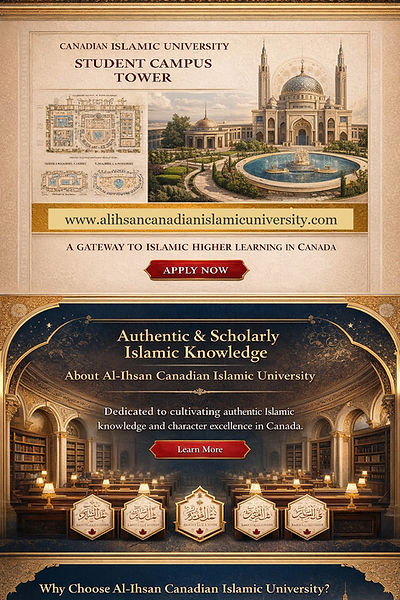
World-Class Professors
World-class professors are nurturing scholars Rabbaniyun Fuqaahaa who teach what they practice. They also possess a combination of advanced education, research experience, teaching expertise, and strong interpersonal skills. They typically hold a doctoral degree, have a strong publication record, and demonstrate a passion for their subject and a commitment to student learning.
Graduate Programs
Masters of Ar-Rāsikhūn in ʿAqīdah Studies (AQD101) – 4 Years
ماجستير الراسخين في دراسات العقيدة (AQD101) – أربع سنوات
English Description
This graduate program provides advanced academic formation in Islamic creed based upon the Qur’an and the authentic Sunnah according to the understanding of the Companions and the righteous early generations.
Students undertake structured study of Tawḥīd, the Divine Names and Attributes, Īmān, Qadar, Prophethood, and the principles safeguarding orthodoxy. The program integrates classical textual mastery, analytical reasoning, and contemporary engagement, culminating in supervised academic research.
Graduates are equipped to preserve doctrinal clarity, address theological challenges, and contribute meaningfully to scholarship and community leadership.
الوصف الأكاديمي باللغة العربية
يهدف برنامج ماجستير الراسخين في دراسات العقيدة إلى إعداد باحثين راسخين في علم العقيدة على أساس القرآن الكريم والسنة النبوية الصحيحة، وفق فهم الصحابة رضي الله عنهم والتابعين ومن تبعهم بإحسان.
يدرس الطالب دراسة منهجية متقدمة في توحيد الله تعالى، وأسمائه وصفاته، وحقيقة الإيمان، والقدر، والنبوة، وأصول أهل السنة والجماعة في تقرير العقيدة والرد على الانحرافات العقدية قديماً وحديثاً.
ويجمع البرنامج بين التمكن من النصوص الشرعية، والتحليل العلمي المنضبط، والبحث الأكاديمي المتخصص، مع إعداد رسالة علمية تحت إشراف أكاديمي.
ويُخرِّج البرنامج علماء مؤهلين لحفظ صفاء العقيدة، وبيانها بالحكمة، والمساهمة في البحث العلمي وخدمة المجتمع.
4) Mission and Vision Statement
Vision Statement
To be a leading academic authority in advanced Islamic creed studies, cultivating scholars firmly rooted in revelation, guided by the understanding of the righteous early generations, and distinguished by intellectual excellence and ethical integrity.
Mission Statement
The Masters of Ar-Rāsikhūn in ʿAqīdah Studies seeks to:
-
Preserve and transmit authentic Islamic creed based upon the Qur’an and Sunnah.
-
Educate scholars grounded in the methodology of the Salaf.
-
Promote rigorous academic research in Islamic theology.
-
Equip graduates to address contemporary theological challenges with knowledge and wisdom.
-
Integrate scholarship, character refinement, and community responsibility.
Core Values
-
Fidelity to Revelation
-
Methodological Integrity
-
Academic Excellence
-
Intellectual Responsibility
-
Ethical Conduct
-
Service to the Ummah
In the Name of Allah, the Most Merciful, the Bestower of Mercy.
Below is a comprehensive academic package prepared with institutional structure, scholarly rigor, and methodological clarity, suitable for formal development and review.
I. FULL CURRICULUM OUTLINE
Masters of Ar-Rāsikhūn in ʿAqīdah Studies (AQD101)
Duration: 4 Academic Years (8 Semesters)
Credit Model: 48–60 Graduate Credits (Adjustable to Accreditation Standards)
Year 1: Foundations of Orthodox Creed
Semester 1
AQD101 – Foundations of Tawḥīd (3 credits)
-
Rubūbiyyah, Ulūhiyyah, Asmāʾ wa Ṣifāt
-
Qur’anic evidences
-
Early creedal articulation
AQD102 – Methodology of Ahl al-Sunnah (3 credits)
-
Authority of revelation
-
Understanding of the Companions
-
Principles of textual interpretation
AQD103 – Classical Creed Text I (3 credits)
-
Study of foundational matn (with commentary)
Semester 2
AQD104 – Īmān: Definition, Components, and Implications (3 credits)
-
Increase and decrease of faith
-
Relationship between belief and action
AQD105 – Qadar and Divine Wisdom (3 credits)
-
Decree, free will, responsibility
AQD106 – Research Methodology in Islamic Theology (3 credits)
-
Academic writing
-
Primary source analysis
-
Citation standards
Year 2: Advanced Doctrinal Studies
Semester 3
AQD201 – Divine Names and Attributes (Advanced) (3 credits)
-
Affirmation without distortion
-
Classical theological disputes
AQD202 – Prophethood and Revelation (3 credits)
-
Finality of Prophethood
-
Authority of Sunnah
AQD203 – Classical Creed Text II (3 credits)
-
Comparative commentary study
Semester 4
AQD204 – The Hereafter (3 credits)
-
Eschatological foundations from authentic sources
AQD205 – Deviant Theological Movements (Historical Study) (3 credits)
-
Methodological critique
AQD206 – Academic Seminar & Research Proposal (3 credits)
-
Proposal drafting
-
Faculty review
Year 3: Comparative & Contemporary Engagement
Semester 5
AQD301 – Contemporary Theological Challenges (3 credits)
-
Secularism, modern skepticism
-
Faith in pluralistic contexts
AQD302 – Comparative Theology (3 credits)
-
Analytical framework (academic study)
AQD303 – Advanced Textual Analysis Workshop (3 credits)
Semester 6
AQD304 – Applied Creed in Society (3 credits)
-
Ethics, governance, leadership
AQD305 – Scholarly Writing & Publication (3 credits)
-
Journal standards
-
Peer review process
AQD306 – Thesis Research I (3 credits)
Year 4: Research & Scholarly Production
Semester 7
AQD401 – Thesis Research II (6 credits)
-
Supervised research
-
Draft chapters
Semester 8
AQD402 – Thesis Completion & Defense (6 credits)
-
Oral defense
-
Academic revision
-
Final submission
Admission Criteria
-
Admission is rooted in the "Rabbaniyyun" curriculum, focusing on authentic knowledge with excellence as practiced by the best early generations (the Prophet's companions and their followers).
Creed and Methodology (Aqida & Manhaj): Applicants must demonstrate an commitment to the methodology of the Salaf as-Salih—seeking proof directly from the Quran, Sunnah, and the consensus of the Companions, while avoiding religious innovations (Bid'ah).
Character and Sincerity (Ikhlas & Akhlaq): High value is placed on sincerity and good character, modeled after the Prophet Muhammad (ﷺ). Applicants may undergo interviews to assess their drive to implement and lead within their communities.
Foundational Knowledge: For advanced programs, a prerequisite of basic Quranic reading proficiency and a general foundational understanding of Islamic principles is required.
2. Academic & Canadian Regulatory Standards
Al-Ihsan Canadian Islamic University maintains rigorous academic benchmarks.
Secondary Education Prerequisites:
Completion of High School Diploma or equivalent (international equivalents must be assessed).
A minimum grade average (typically 90%) in core subjects like Simplified Arabic, Islamic Sciences, and Quran Memorization.
Language Proficiency:
English: Mastery of the English language (IELTS/TOEFL scores for non-native speakers) to ensure success in a Canadian academic environment.
Arabic: Proficiency in reading Quranic Arabic is often required for core Islamic studies.
Verification & Integrity: Submission of official, verifiable academic transcripts and letters of recommendation from recognized community or academic leaders.